

Highly sensitive people are featured as physically and emotionally more easily stimulated than others do. Being sensitive has both advantages and disadvantages. Yet, in many cultures possessing this trait is not considered ideal. The sensitive person has probably been told to “get over it” as if it were a defect, to feel self-worth and self-confidence. As an adult, it could have been harder to find the right career and relationships.
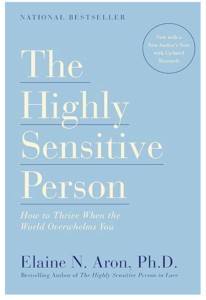
Psychologist Elaine Aron who coined the term “Highly Sensitive Person” articulates that it is not a trait or a flaw that one would briefly describe as “introversion” or “shyness”. Highly Sensitive Persons (HSPs) are special but deeply misunderstood. She defines the challenges and assets of HSPs in her distinguished book, product of 5 years of clinical research, in-depth interviews and individual consultations with hundreds of HSPs.
First and foremost identifying herself as an HSP, she writes :
Having a sensitive nervous system is normal, a basically neural trait. It occurs in about 20% of the population…I am a research psychologist, university professor, psychotherapist, and writer. What matters most, however, is that I am an HSP like you. I am definitely not writing from on high, aiming down to help you, poor soul, overcome your “syndrome.” I know personally about our trait, its assets and its challenges… As a child at home, I hid from the chaos in my family. At school I avoided sport and studied most of the time. In college my life became more difficult…I finally graduated from the University of California at Berkeley. But I spent my share of time crying in restrooms, thinking I was going crazy. It took twenty-five years for me to gain the information about my trait that made it possible to understand my reactions and complete the doctorate. I was simultaneously delighted and ashamed of not being “out there.” I was vaguely aware of my lost opportunities to learn, to enjoy more public recognition of my abilities, to be more connected with all kinds of people. But from bitter experience I thought I had no choice…there was my sense of being flawed.
[…]
We are a package deal, however. Our trait of sensitivity means we will also be cautious, inward, needing extra time alone. Because people without the trait (the majority) do not understand that; they see us timid, shy, weak or that greatest sin of all, “unsociable.” Fearing these labels, we try to be like others. But that leads to our becoming overaroused and distressed. Then that gets us labeled “neurotic” or “crazy,” first by others and then by ourselves.
On the challenges of HSPs, she explains that sensitivity also means perceiving the subtle :
- HSPs do take in a lot – all the subtleties others miss. But what seems ordinary to others, like loud music or crowds, glaring lights, strange odors, clutter and chaos can be highly stimulating and thus stressful for HSPs. Most people walk into a room and perhaps notice the furniture, the people – that’s about it. HSPs can be instantly aware, whether they wish to be or not, of the mood, the friendships and enmities, the freshness or staleness of the air, the personality of the one who arranged the flowers.
- Another major challenge of the HSP is the ardent need to please the other. Being so eager to please, we are not so easy to liberate. We are too aware of what others need. This may buffet us for years… There is one essential rule : Boundaries take practice ! Make good boundaries your goal. They are your right, your responsibility and your greatest source of dignity.
What follows is on the average, nobody has all these traits. But compared to non – HSPs, most of the HSPs are:
- Better at spotting errors and avoiding making errors.
- Highly conscientious.
- Able to concentrate deeply.
- Especially good at tasks requiring vigilance, accuracy, speed, and the detection of minor differences.
- Able to process material to deeper levels of what psychologists call “semantic memory.”
- Often thinking about our thinking.
- Able to learn without being aware we have learned.
- Deeply affected by other people’s moods and emotions.
Our bodies are different too. Most of us have nervous systems that make us:
- Specialists in fine motor movements.
- Good at holding still.
- “Morning people.” (Here there are many exceptions.)
- More affected by stimulus like caffeine unless we are very used to them.
- More “right-brained” (less linear, more creative in a synthesizing way.)
- More sensitive to things in the air. (Yes, that means more hay fever and skin rashes.)
If you are an HSP, it is hard to grasp that you have some remarkable ability.
How do you compare inner experiences ? Not easily. Mostly you notice that you seem unable to tolerate as much as other people. You forget that you belong to a group that has often demonstrated great creativity, insight, passion, and caring – all highly valued by society.
She highlights the vital role of HSPs in society :
For better or worse the world is increasingly under the control of aggressive cultures – those that like to look outward, to expand, to compete and win. This is because, when cultures come in contact, the more aggressive ones naturally tend to take over. Expansion, freedom and fame are good. Those are the values of the warrior-kings.
For aggressive societies, to survive however, they always need that priest -judge-advisor class as well. This class balances the kings and the warriors. Its members are respected… They have the foresight, for example, to look out for the well-being of those common folks on whom the society depends, those who grow the food and raise the children. They warn against hasty wars and bad use of the land. In short the advisory class insists on stopping and thinking.
HSPs tend to fill the advisory role. We are the writers, historians, judges, artists, researchers, theologians, therapists, researchers, teachers, parents and plain conscientious citizens. The warriors have their bold style, which has its value. But we, too, have our style and our own important contribution to make.
A few words of wisdom derived from her outstanding experience as an HSP and from her erudite research :
- Appreciate yourself
- Praise yourself for taking risks and learning something new rather than for your successes; it will help you to cope with failure.
- Try not to constantly compare yourself to others; it invites excessive competition.
- Give yourself opportunities to interact with other gifted people.
- Do not overschedule yourself. Allow time to think.
- Keep your expectations realistic.
- Do not hide your abilities.
- Be your own advocate. Support your right to be yourself.
- Prepare overarousal strategies in mind and body like a short speech, mantra, position, posture, etc.
- One solution to all of this job / vocation search is not to insist that your gifts all be expressed at work. Express yourself through private projects and art, schemes for parallel self-employment, and through life itself.
Duygu Bruce